In a recent post by the economist Richard Murphy, he argues that political claims regarding out-of-control social security expenditure in the UK are fundamentally false and rely on a misinterpretation of financial data. The author examines historical and projected government spending to demonstrate that current benefit costs are neither unprecedented nor exceptionally high when measured against national income and GDP.
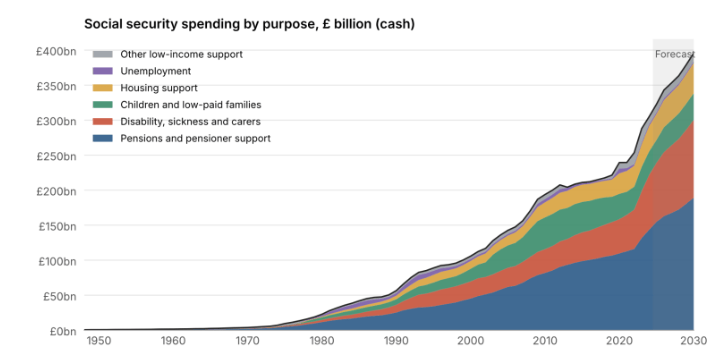
This is the picture the government wants you to see – an accelerating, out of control expenditure on welfare
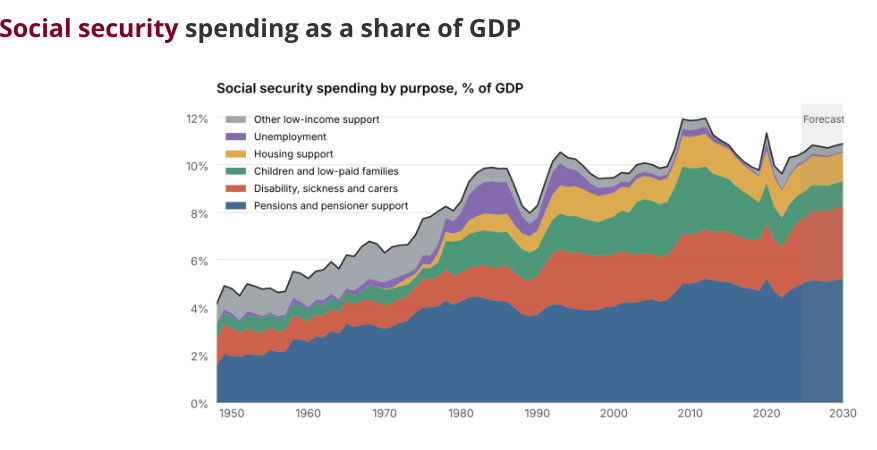
And this is the true picture of social security spending as a share of GDP
You can see the blog with graphs here>>>. I have sent out his key points below.
Key points:
Post-War Baseline (1948/49): At the start of the modern welfare state, social security accounted for 4.1% of GDP and 10.7% of total government spending
Latest recorded year (2024/25): Expenditure stood at £305 billion, representing 10.4% of GDP and 23.6% of total government spending
Historical Peaks:
- As a share of GDP, spending peaked at 12.0% in 2012/13.
- As a share of total government spending, it peaked at 28.1% in 1996/97.
Current vs Historical Context: Current and forecast spending as a percentage of GDP is lower than levels recorded between the early 1990s and late 2010s. While total spending in cash terms rises due to inflation and population growth, expenditure relative to national income remains within historic precedents. Cash spending is projected to reach £395 billion in 2030/31
Why do politicians misrepresent the reality of the social security crisis?
This could be a good question to put in a letter to Jayne Kirkham MP. Some of the reasons are:
Conflating Cash Growth with Real Economic Burden: Politicians frequently point to rising raw cash spending (denominated in pounds) to claim that welfare costs are “running out of control”. However, they fail to distinguish between cash totals and spending measured as a percentage of GDP or total government expenditure. Because of inflation and population growth, cash figures inevitably rise, but spending relative to national income is actually lower today (and in projections) than it was from the early 1990s to the late 2010s
Justifying Neoliberal Reforms and Cuts: Political rhetoric deliberately frames social security as a crisis to manufacture public support for spending cuts and neoliberal welfare reforms.
Distracting from Pension Costs: Political debates often focus on disability or working-age benefits, even though pension payments account for 47% of the total social security budget. Because reducing pensions is politically risky, politicians focus scrutiny on smaller benefit categories instead of acknowledging that overall expenditure is heavily driven by state pensions
Deliberate Mis-statement vs. Financial Incomprehension: The commentary argues that politicians either suffer from a fundamental inability to understand basic economic metrics (confusing cash growth with GDP shares) or are deliberately mis-stating the data to victimise vulnerable citizens and undermine the welfare state



Leave a Reply