We are in the middle of a public funding crisis which is likely to get worse as a result of the war in Iran. We will also see a new cost of living crisis which will hit our pockets even as council tax and water bills rise.
Money seems to be in short supply everywhere – or is it?
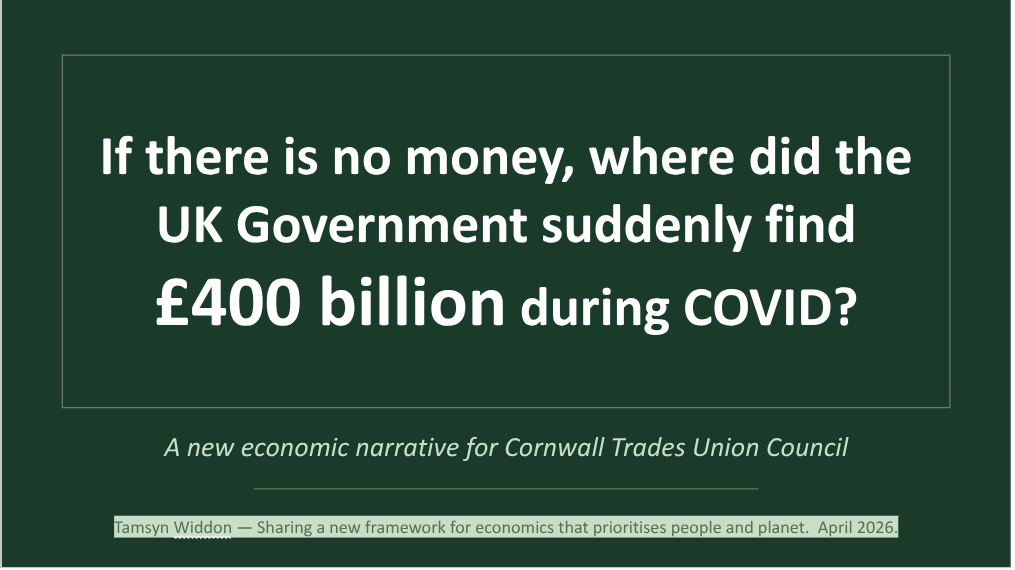
Recently, Tamsyn Widdon, ex councillor and economics teacher, gave an incisive presentation on government finances to Cornwall Trades Union Conference. It was a clear factual presentation which exposed the lie that the UK government cannot afford to fund public services and a decent welfare state. Here is why:
- The government is the monopoly issuer of its own currency. The British Pound is public property owned by the government. Not only can it instruct the Bank of England to fund the money it needs, it also licences the main high street banks (e.g. Natwest, Barclays, Lloyds) to electronically create money in the form of personal or business loans.
- A government with its own currency such as the UK is not reliant on tax revenue to fund services. It first spends money into existence. For money to be tax or borrowed it first has to exist in the real economy – you cannot tax or borrow what is not there! For money to exist, the government first spends and then taxes back. It is spend and tax back, not tax and spend – the reverse of what we are told.
- Spending during the Covid Pandemic proves the argument. Roughly £400 billion was created in a matter of weeks to fund the furlough scheme, vaccine procurement, business loans and NHS expansion. Where did that money come from? This was not tax money! The government went through the motions of ‘borrowing’ the money from the financial money markets through the sale of government bonds (IOU’s) in large volumes. At the same time, the Bank of England, a state institution, created new money electronically and used it to buy government debt equal to the amount being sold. Basically, one arm of the state (HM Treasury) sold government bonds (IOU’s) to the private sector while another arm of the state (Bank of England) bought it back!
- This convoluted process acted as a fig leaf for the pretence that the government can only fund public services by either taxing or borrowing. The Covid pandemic exposed this myth.
- Claims that the government has a ‘financial black hole’ or ‘the government budget is like a household budget’ are false. If you hear it said, call it out as a lie: mention the £400 billion spent in response to the pandemic. Claims of a ‘financial black hole’ have to be seen in the context of the government’s own ‘self-imposed rules’ on spending – I stress self-imposed. There is no external coercive force imposing its will on the government.
- This brings me to government debt: government debt is private sector savings. A government with its own currency doesnt have to borrow from financial markets nor does it rely on tax revenue. The fact that the government borrows from financial markets is part of its own self-imposed fiscal rules; it could just as easily change these rules and has done so in the past several times.
- Finally, council taxes. While Cornwall Council is part of the institutional governance framework, local authorities are currency users. In contrast central government is a currency issuer. Members of the public, local government, local businesses are currency users, they use the currency that the government issues. While currency users such as Cornwall Council do indeed have to balance the books and remain within budget, a government with it own currency does not because it issues the currency. Hold on to the fact no matter what!
The bottom line: we have been played. Politicians count on public ignorance to run rings round us. If you want to challenge the prevailing austerity narrative, educate yourself. Do your own research, look up MMT UK. Then start asking awkward questions of your local MP, your councillor, and others in positions of power.
 The New Kows
Leave a comment