How do we find a way of enabling local people and communities to articulate their own vision? How do we equip them with the power and resources they need to shape their own future and to have a real say over decisions and services that affect their lives? These were some of the questions we wrestled with on an ‘away day’ in Sheffield a while back when I was part of a group of around twenty people drawn from different areas and interests, who wanted to thrash out a ‘Peoples Charter’.
A charter is different to a party political manifesto in so much that it is a short concise document and tends to be bottom up, not top down. It is an alternative to the retail politics of today which positions us as bystanders and consumers of party political messages, not active agents of our own future.
The most recent initiative for a national charter is the one created by House of The People which shows much promise. That in turn was inspired by the famous Chartist Petition which emerged out of the Chartist movement two centuries ago. It was Britain’s first mass working-class movement, demanding political reform and one of its leaders was one William Lovett from Newlyn Cornwall. These were its six demands:
- All men to have the vote (universal manhood suffrage)
- Voting should take place by secret ballot
- Parliamentary elections every year, not once every five years
- Constituencies should be of equal size
- Members of Parliament should be paid
- The property qualification for becoming a Member of Parliament should be abolished
You can see that the vote was for men not women but set aside that flaw for the moment; there are two striking points.
The first is one of omission: their demands did not include reference to the severe economic hardship and poverty that drove the chartist movement. The brutal implementation of land enclosures drove large swathes of the rural population into the harsh urban environment that accompanied the Industrial Revolution, a period known as the “Hungry Forties”. Why no reference to this in the charter? Because the Chartists clearly understood the root cause of their poverty as the absence of a functioning democracy which might allow their voice to be heard. There was no point in campaigning on poverty issues or a fair wage when voting rights were restricted to a propertied elite. We have forgotten that lesson. Today we labour under the illusion we still have a democracy.
The second point is the brevity of the document and the terse language used. It is short, direct and to the point. Even a child could understand it. Compare that to the slippery promotional language used in party manifestos or the politicians’ linguistic sleight of hand that dodges uncomfortable questions while putting forward a point completely unrelated to the question asked.
Today, the Chartist model remains as relevant as ever given the present crisis in democracy. While certain achievements of the chartists live on such as the right to vote and free and fair elections, these now form the veneer of democracy while its substance has been gutted. State power has been overcentralised and captured by money, itself the result of growing wealth inequality which sees the richest 50 families in the UK holding more wealth than half of the UK population, (34.1 million people).
The malign influence of money
Excessive wealth breeds excessive political interference: a wealthy elite fund the parties we vote for, own the papers we read, and deploy an army of lobbyists, consultants and think tanks to shape the legislative agenda in ways that further their interests but harm ours. A century ago the U.S. Supreme Court Justice Louis D. Brandeis famously stated:
“We must make our choice. We can have democracy in this country, or we can have great wealth concentrated in the hands of a few, but we can’t have both,”
That applies no less to the UK than it does to America. Yet the urgency of that choice is lost on most of us. The multiple crises we face – from child poverty and housing to collapsing public services, climate and ecosystem collapse – have their roots in state capture by a wealthy elite. A rigged democracy no longer answers the needs of its citizens. Unless we see this clearly, there is very little that can be done.
The charter as a counterweight to technocratic governance
If we are to rescue our democracy from the slide into a technocratic, managerial system where optics and sound bites matter more than substance, then we need to return to the simplicity of the chartist approach: ordinary people coming together to thrash out their own demands in a short, accessible document written in plain English. Political power now hides behind a complex system of governance with its obscure jargon, convoluted policy frameworks, and unaccountable public agencies. Its epicentre is Whitehall and Westminster. This opaque overcentralisation of power is at the heart of a failing democracy that places a vast distance between the needs of ordinary people and a paternalistic ‘we-know-best’ political and bureaucratic elite. The result is a widespread sense of alienation and powerlessness that has dangerous consequences for both basic freedoms and societal wellbeing.
Adopting the chartist approach at a local level
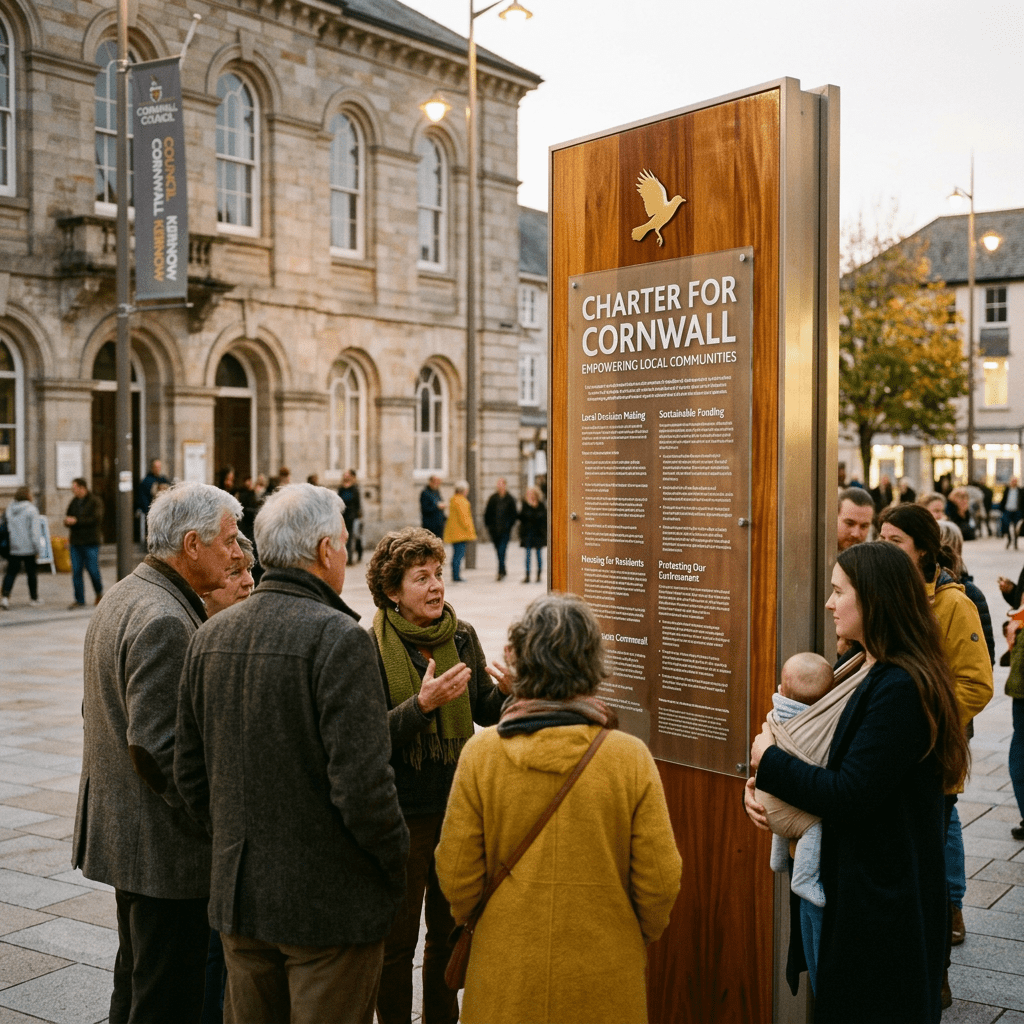
If we are to reverse the transition from democracy to plutocracy – rule by the rich – we have to start at the opposite pole from a top-down overcentralised state – the locality in which we live. It has to be a local town or parish charter which lays out in plain English a set of clearly defined goals and guiding principles. Different localities will come up with different charters but if these remain true to the broad theme of local communities taking back power then there is likely to be much common ground. The charter then becomes the yardstick by which to measure what matters to local people, not key performance indicators written in Whitehall or party political manifestos.
Clearly, brandishing a local charter will not magically bring about radical system change – but it is the first much needed step to doing so. It is a deliberately ambitious enterprise with communities pushing for the progressive realisation of its demands over time. And the process is part of the outcome: top down is replaced by bottom up, with communities regaining a sense of voice and agency. It is the local chartist movement that starts to shift the political centre of gravity away from the centre to the local.
While such a movement might come up with a multiplicity of local charters, over time such a democratic ecosystem would see movements learn, adapt, borrow and build on each other’s efforts. That organic process would offer opportunities for an umbrella charter, in effect a prototype constitution for Cornwall as it strives for greater autonomy and independence


Leave a Reply